Throughout and/or at the end of the course, the instructor should grade relevant assessments, under the supervision of the coordinator.
Many activities on Moodle can have an automated grading, requiring no further actions:
- SCORM packages
- Quizzes
- Attendance to Zoom sessions
While others require the intervention of the instructor:
- Assignments: see tutorial on how to grade
- Forum: use the “Grade user” button to add grades.
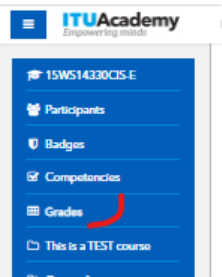
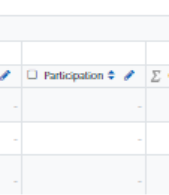
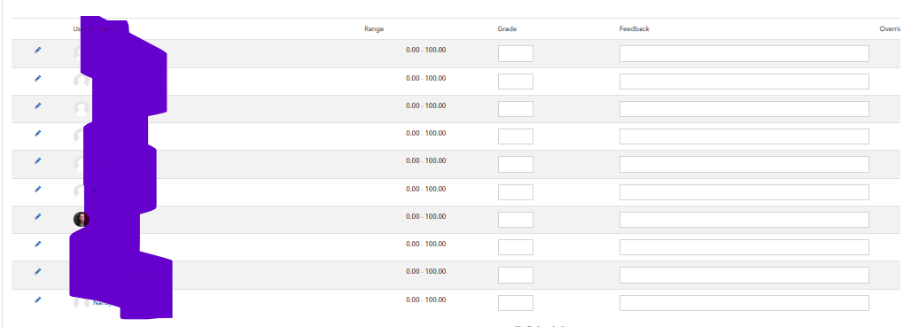
- Attendance: if not online or not through the Zoom integration with Moodle. Go to the grades, locate the grade item participation (previously added through the gradebook set up) and click on the edit icon, enter grades for each participant and click “Save”.
Peer and Group Assessments for face-to-face instructor-led training courses
Peer and group assessments play a critical role in enhancing the learning process through feedback. Through evaluating each other's contributions, participants are encouraged to hone their critical thinking, fostering a deeper understanding of the subject matter and improving their own performance. This practice promotes collaboration, highlighting the importance of teamwork and maximizing peer learning.
Peer reviews also encourage self-reflection and provides individuals with insight into how their work is perceived by others, promoting self-awareness and personal growth in areas like leadership, adaptability, and cooperation. Through creating a collaborative setting, it leads to higher participant engagement and a more complete learning experience.
Recommended process
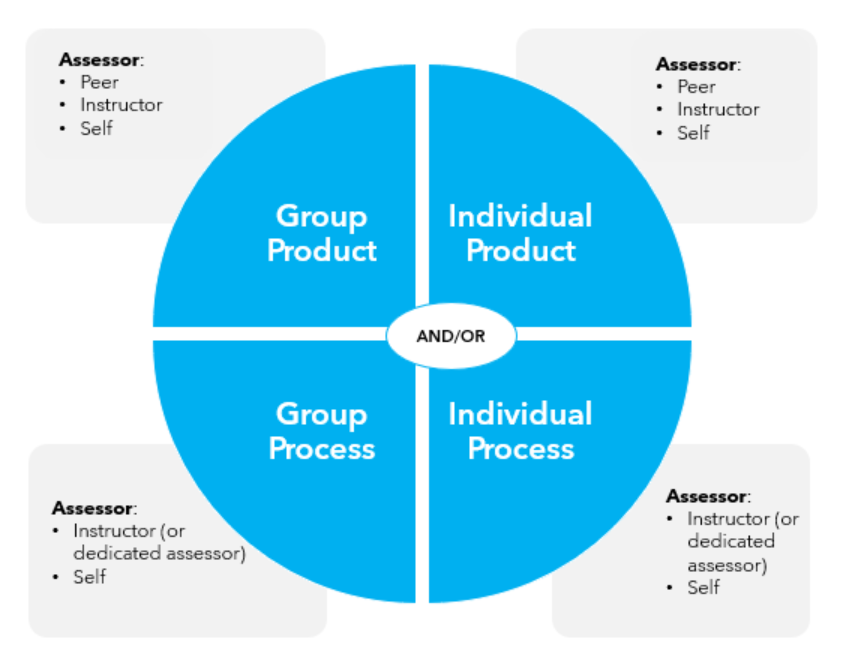
The assessment can target A. the product and/or B. process(es) at both group and/or individual level (the table below captures the ITU Academy recommended approach (see Steps 1-3). The assessment criteria, weighting and rating (or alternatively, ranking), will vary depending on the training’s objectives and desired outcomes in terms of the targeted knowledge, skills and attitudes.
Additional resources
Please consult the following resources for more in-depth theory and concrete examples:
- Cornell University’s Center for Teaching Innovation – How to evaluate group work
- Ghent University – How to assess group work
- University of New South Wales Sydney – Assessing by group work
Level | What is assessed | Purpose | Weighting | Step 1: | Step 2: | Step 3: |
|---|---|---|---|---|---|---|
Group | Product | Measure the quality of the work | Assign weighting for each level used.
(For options on grading, see Table 1 here)
(Note: participants must be made aware of the weighting, the assessment method and criteria, at the start of the training course.) | Apply a predetermined rating scale assessing the final product against its desired/optimal characteristics, e.g. compliance to the initial requirements, problem identification, strength of formulated solution / arguments, analysis of variables, accuracy of answered questions, drawing of well-formulated conclusions. (Note: this is training-specific and dependent on the proposed learning objectives and desired outcomes in terms or skills, knowledge and attitudes). | Encourage reflection on progress and product quality at several points in the process (intermediate checks) Compare end product to peers’ work. | |
Process | Assess the way the group functions together |
- | Using direct observation, apply a predetermined rating scale targeting core skills for the assignment, e.g.: •Effectiveness: task management and allocation of responsibilities | Place emphasis on how members view their group’s work traits. (Questions to ask: what went well, what can be improved, what they would do differently / what they would keep or discard from the process, how did they approach the objective setting, role distribution) | ||
Individual | Product | Check level of acquired knowledge and skills | See Group product category | See Group product category | ||
Process | Evaluate individual skills and interaction |
- | Using direct observation, apply a predetermined rating scale targeting core skills for the assignment, e.g.: •Accountability, contributions | Allow participants to compare their working practices with those of their peers. (same as for Group process category) | ||