Learning objectives
Capture the knowledge and skills acquired by the participants as a result of the training. Please use the revised Bloom’s taxonomy, avoid words like “Understand” and “Know”, use action verbs (use this cheat sheet) to create specific and measurable learning goals.
Methodology
An overview of the proposed instructional approach for the training course needs to be included. It should provide an accurate picture of how the learning process will ensue, e.g. self-study elements, tutored interventions, peer/social learning, inclusion of pre- or post- work/tasks, presentations, case studies, group & individual work, types of activities, reflection, or assignments.
The ITU Academy recommends an experiential learning approach, making use of case studies, problem-based learning activities, (self-) reflection, demonstrations, gamification, simulation (where applicable). Please consult the ITU Academy quality assurance checklist (Step 2) for reference.
Assessment and grading
All ITU Academy training courses must have some form of knowledge assessment: quiz, test, exam, or graded assignment. These should target the course’s learning objectives specifically and can be combined with other requirements (e.g. attendance, forum contributions), towards establishing the overall Pass/Fail criteria.
The overall pass grade for the courses to obtain a badge or a certificate should be 70% or more. For online, self-paced courses, a total score of 80% is required to obtain the ITU Academy badge.
Training details & instructional approach
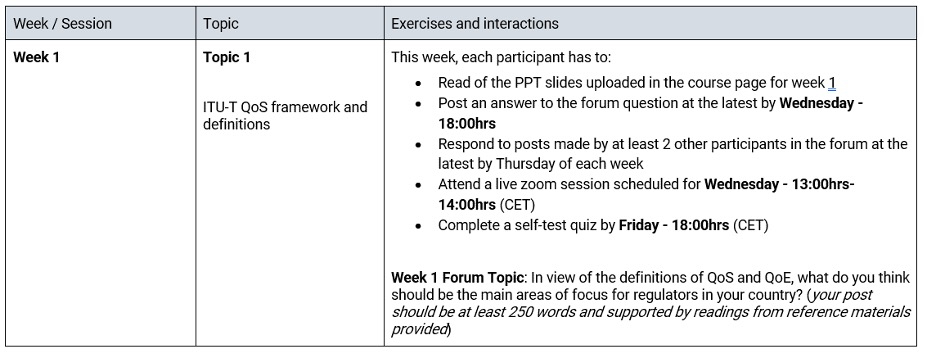
This section, in form of a table, should contain a detailed breakdown of the training in terms of content and instructional approach. It should include:
- Schedule: information regarding the timings for the sessions. It includes specific dates and timings (for the instructor-led live sessions).
- Sessions/topics covered: details on which topics are covered across the full duration of the training course
- Key learning points: expands the previous methodology section to detail the intended outcomes of each session
- Training activities: information regarding the planned approach for the sessions, specifically:
- types of materials to be used (e.g. videos, self-study, live or recorded presentations)
- interactions and engagement activities planned (e.g. problem-based learning activities, case study analysis, reflection exercises)
- session format (e.g. lecture, plenary/breakout rooms discussions)
- assessments administered (e.g. formative and/or summative quizzes per module, final exam, assignment)
- social/peer learning elements (e.g. forum participation, groupwork, projects)
See an example below of a table filled: